
The majority of pressure sensor designs that are used in industrial applications have some form of mechanical isolation diaphragm that protects the sensor element from the pressure media.
In order to translate the pressure effectively to the sensor element, without energy loss and to provide sufficient sensitivity, it is necessary that the design of the mechanical package minimizes the displacement of the diaphragm.
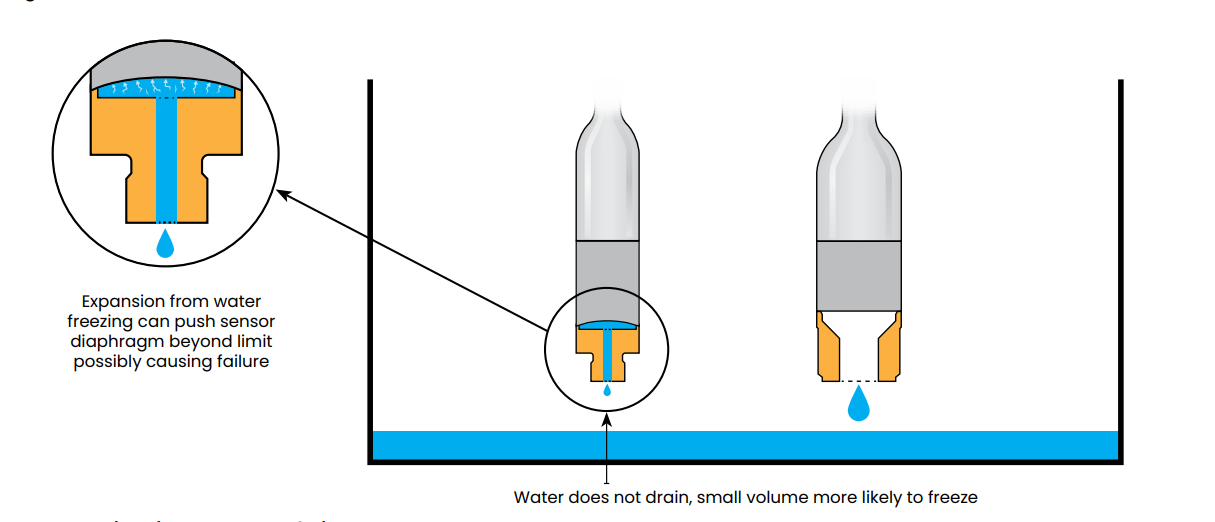
Consider, however, if the media being measured is water and temperatures in the environment can dip below freezing. The volume of freezing water can expand by approximately 9% which, in a closed or confined space, can translate to exerted pressures in excess of 25,000 psi.
These levels of displacement create an 'overpressure' are well beyond the design capability of many pressure sensors. If water freezes within the pressure port of a pressure sensor it will cause damage and/or failure.
Fortunately, it is possible to mitigate to effects of freezing water environments through installation considerations and pressure port design.
If pressure sensors are mounted in a vertical orientation with the pressure port pointed down, gravity will help water to drain out of the pressure port to prevent damage from freezing.
This installation practice can be enhanced by a pressure port design that aids in water draining out of the dead-volume of the pressure port. Referencing Fig. 1, by increasing the dead-volume and angling the sides of the interior the potential damage of freezing water can be minimized.
- Contact Us
- Continue exploring Druck's Technical notes
- Find out more about Druck's pressure sensors
- Request a quote for your application
