
High temperature issues For the most part, the pressure sensor is a chunk of metal. Over time, worst case, you can assume, this chunk of metal will reach the highest temperature it is exposed to. This includes the sensing element, electronics, and electrical connection.
Most generic industrial pressure sensors have an upper limit operating temperature in the range of 80°~125°C. Compensated temperature limits can be lower. Using a sensor at a temperature beyond what it is rated for, will ultimately result in failure or a meaningless inaccurate pressure reading.
For applications where the pressure media temperature is beyond the operating or compensated limit, there are two solutions. There are high temperature pressure sensors available on the market. These will come with a much higher price tag and can have lower performance. The other solution, most favored, is to reduce the pressure media temperature before it comes in contact with the sensor. This has the benefit of allowing a generic industrial sensor to be used and will be a lower cost solution.
Solutions Isolating an industrial pressure sensor from a high temperature pressure media is commonly done by three methods. These are a stand-off pipe, capillary tube, and a cooling tower. All three of these are effective by providing distance or thermal isolation between the hot media and the sensor.
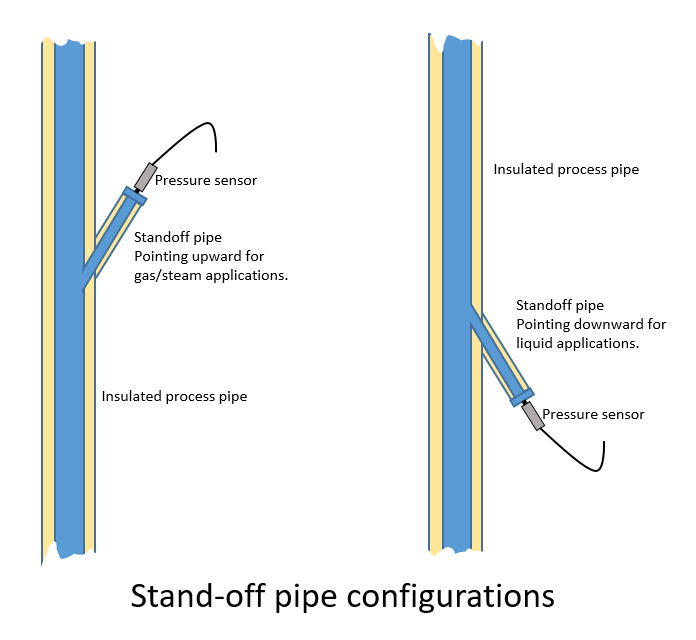
Stand-off pipe A stand-off pipe (also known as an impulse line) is the simplest method of providing thermal isolation for a sensor. It is simply a section of pipe taking the media away from the hot source. As a general rule of thumb, a stand-off pipe will cool the media ~37°C for every 30cm of length.
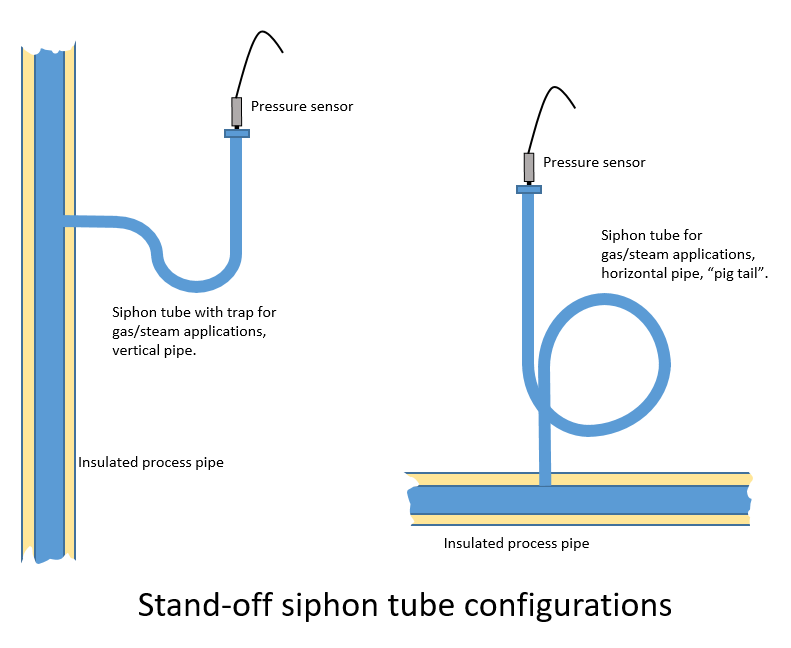
For some applications, e.g. steam, a loop in the stand-off pipe (“pig tail” or siphon tube) to block the hot media from contacting the sensor. This can also be in the form of a trap. It is also best to insulate the hot media source or shield the pressure sensor to prevent radiant and convection heating for the sensor.
Generally, for gas and steam applications, the stand-off pipe should be pointing upwards to facilitate the condensation draining away from the sensor. For liquid applications, the stand-off pipe should point downward to ensure the process media fills the pipe.
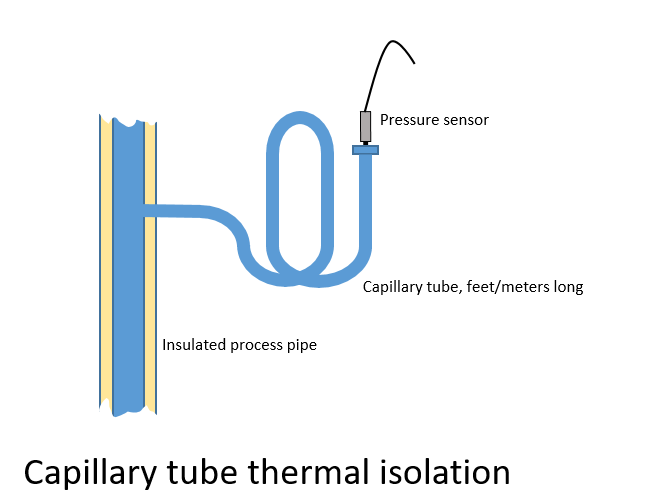
Capillary tube Remotely mounting the pressure sensor and using a capillary tube provides the maximum isolation between a hot process pipe and a pressure sensor. Capillary tubes can be several feet/meters long as needed. Ultimately, the pressure sensor is at ambient environmental conditions.
A stand-off pipe can contain a trap. The trap contains a liquid to provide media isolation to the pressure sensor. These are sometimes referred to as a pig tail. Care has to be taken in colder climates to ensure the liquid in the trap doesn’t freeze. Siphon tubes or pig tails are commonly used in steam applications.
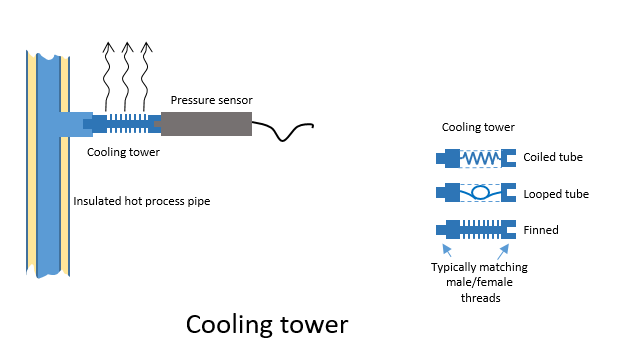
Cooling tower Cooling towers are devices used in line with the pressure sensor to cool the pressure media before it comes in contact with the sensor. The device works by expanding the surface area of the connection between the process pipe and the sensor.
This increases the heat dissipation by radiation and convection. There are two basic types of cooling towers, finned and extended tube. The finned cooling towers have fins increasing the surface area. In most cases, the fins and the whole tower are machined from one block of metal (e.g. stainless steel, aluminum, etc).
The extended tube uses a smaller diameter tube that is coiled or looped between the process to sensor connection to increase the surface area. These usually have a perforated sheath covering. This sheath provide mechanical strength to the assembly.
Cooling towers are compact, efficient, and can generally drop a process temperature by 38~150°C. Manufacturers provide cooling factor specifications based on very specific conditions. Pressure sensor applications can vary widely and are unlikely exactly replicate the exact conditions of the tower when it was specified.
Such conditions generally not provided are air flow, process media density, process piping schedule, process flow rate, etc. It is prudent to derate the cooling towers specification to sufficiently account for these variables. Maximum pressure rating and maximum operating temperature are also considerations. These are generally well defined by the manufacturer.
Conclusion The correct method of protecting a pressure sensor from a high temperature process depends on many factors. Each application is unique and requires consideration of all the factors that can have a thermal impact on the sensor.
A complete thermal evaluation of an application and solution would likely require very high end and expensive thermal modeling software and a complete knowledge of all thermal factors impacting the sensor. For most users, this modeling capability is out of reach or impractical.
These solutions are good solutions as long as they are not pushed to their limits. For example, using a cooling tower with a 100°C cooling capability on a 125°C sensor and a 225°C process fluid would not be a good idea. A cooling tower rated for 200°C (or higher) cooling would be a better choice.
Having 50% derating can account for unforeseen thermal load on the sensor. Other design considerations for an application includes valves, drains, vents, etc. For simplicity, these are not shown here but are needed in most applications.
In all applications it is never a good idea to place the sensor directly above the hot process pipe. Convection from the hot pipe will add to the thermal load on the sensor. The sensor should always be placed to the side or below the hot pipe.
With a smart design and adequate design overhead, a generic industrial pressure sensor can be used in a high process temperature application. Ultimately, this saves the cost and makes higher performance solutions available to the system designer.
- Contact Us
- Discover more technical notes from Druck
- Learn more about Druck's market leading pressure sensor range
