
High accuracy pitot static testers like those in the Druck ADTS product portfolio require periodic calibrations to guarantee their datasheet specifications.
Typically, this would be carried out with a deadweight tester (DWT), but these devices are high in price, cumbersome in size and often difficult to setup and maintain correctly. Based on these drawbacks, Druck has developed a lightweight, portable and maintenance free transfer standard.
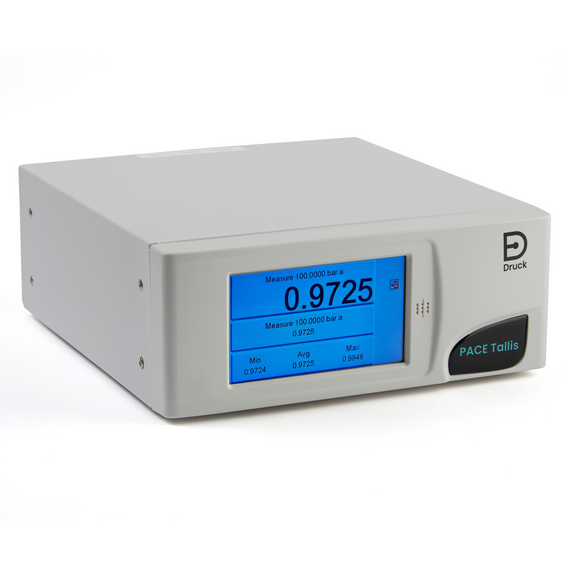
PACE Tallis is a new bench top / panel mount pressure indicator that utilises Druck Ltd’s market leading TERPS sensor technology to provide a highly stable, highly precise, and highly accurate digital transfer standard calibrator.
Fleet operators of Druck Ltd’s ADTS 405 MkII or ADTS 403 pitot static testers can benefit by using the PACE Tallis to complete either a manual or automated calibration of their test set without the need for a DWT.
The inclusion of TERPS sensor technology in the Tallis Transfer Standard calibrator, is now providing end-users with tangible and significant productivity gains along with improved uncertainty in high precision manual and automatic pressure calibrations compared to more traditional methodologies such as deadweight testers.
A detailed look at the benefits of Tallis can be seen below.
By maintaining a PACE Tallis transfer standard calibrator onsite allows for calibrations to be autonomously completed comfortably within an hour as opposed to shipping to external calibration labs which would result in the units being unavailable for a few weeks and a need for having an extended fleet to cover for units being out for calibration so as not to impact ongoing Operations.
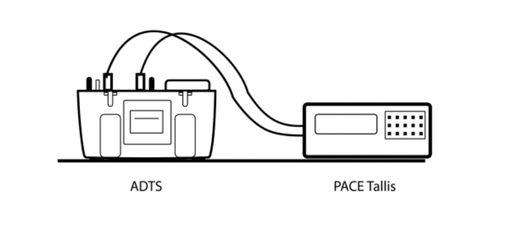
Completing a calibration on the ADTS 405 Mk II or ADTS 403 is a well documented standard process and utilises the internal pressure and vacuum controllers to provide the pressure source for the calibration, with the PACE Tallis providing the reference standard. This represents the normal mode of operation compared to using an external pressure source and is shown below.
The calibration procedure measures then improves the accuracy of the main static & pitot channel transducers if required. The procedure applies known pressures to the ADTS whilst entering the applied pressure using the hand terminal or local keypad. After all calibration points have been entered, the ADTS automatically calculates and corrects for offset (zero), slope (span) and non-linearity to optimise the overall uncertainty of the ADTS.
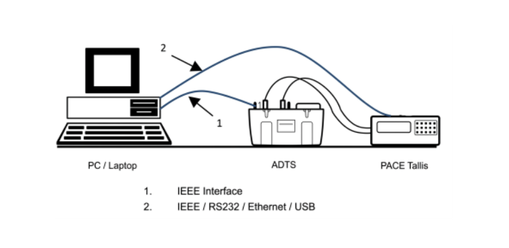
Calibration facilities are also available over the IEEE 488 SCPI interface to allow automation of the process whereby the set-up of which is shown below.
In conclusion, the combination of a Druck ADTS with PACE Tallis reference standard creates an unrivalled calibration solution for your avionic instrumentation in terms of cost of ownership, accuracy, and reliability.
- Contact Us
- Continue exploring Druck's Technical notes
- Watch a visual demonstration here
